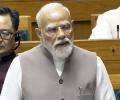
Prime Minister Narendra Modi addressed Parliament on the West Asia crisis, advocating for dialogue and diplomacy, ensuring the safety of Indians in the region, and addressing concerns about fuel and food security.
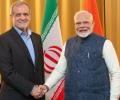
Prime Minister Narendra Modi held a telephonic conversation with Iranian President Masoud Pezeshkian, discussing recent developments in West Asia and reiterating India's emphasis on the importance of freedom of navigation in the Strait of Hormuz. Modi welcomed the recent peace understanding between the US and Iran, stressing dialogue and diplomacy for regional stability. India will also send representatives to the burial ceremonies of Iran's late Supreme Leader.

Prime Minister Narendra Modi has called for the resolution of the West Asia crisis and the Ukraine conflict through dialogue and diplomacy, asserting that military action alone cannot achieve lasting peace. He made the remarks after talks with Norwegian Prime Minister Jonas Gahr Store.

Foreign Secretary Vikram Misri stated that the Indian government has no involvement or official support for Track 2 discussions on India-Pakistan ties, even when retired Indian officials participate. He clarified that such participants speak in their personal capacities and do not represent the government's views, and New Delhi does not take cognisance of these private events.

Pakistan's Prime Minister Shehbaz Sharif has engaged in extensive diplomatic efforts to de-escalate the conflict in West Asia, offering to host talks between the US and Iran and engaging with leaders from Saudi Arabia, Qatar, Malaysia, the UK, China, and the European Union.

Modi's comments on underlining the importance of ensuring the safety of seafarers came against the backdrop of growing anger in India over the killing of the three Indian crew members in a US military attack on a merchant ship off the coast of Oman last week.

Prime Minister Narendra Modi and French President Emmanuel Macron discussed the escalating situation in West Asia, emphasising the need for dialogue and diplomacy to restore peace and stability in the region.

Prime Minister Narendra Modi has expressed deep concern over the escalating situation in West Asia, emphasising the need for dialogue and diplomacy to resolve disputes. India is closely monitoring developments to ensure the safety of its citizens in the region.

Prime Minister Narendra Modi and French President Emmanuel Macron discussed the escalating situation in West Asia, emphasising the importance of dialogue and diplomacy to restore peace and stability in the region.

The Indian embassy in Ukraine is actively monitoring the critical situation of 13 Indian seafarers aboard MV AMIR1, who are reportedly under threat from drone and missile attacks near Ukraine's Black Sea coast.

A top Swiss official has emphasised the growing importance of science and technology in international affairs, leading Switzerland to prioritise anticipatory science diplomacy in its foreign policy. Collaboration with India reflects a shared vision between two global innovation leaders.

Pakistan's Foreign Minister Ishaq Dar met with his counterparts from Egypt and Turkiye in Islamabad ahead of a quadrilateral summit, including Saudi Arabia, to discuss the ongoing conflict in West Asia and explore avenues for peace.

External Affairs Minister S Jaishankar has affirmed India's commitment to ensuring issues like a free, open, and rule-based maritime order, seafarer safety, and countering terror financing receive due attention at the UN Security Council during its 2028-29 term.
National Conference President Farooq Abdullah has voiced his concern over the escalating violence in West Asia, urging all parties to prioritise dialogue and diplomacy to de-escalate tensions and protect civilian lives.

Prime Minister Narendra Modi and Indonesian President Prabowo Subianto have significantly advanced the India-Indonesia Comprehensive Strategic Partnership, securing crucial agreements on defence, critical minerals, and maritime security, including BrahMos missile supply and Sabang port development.
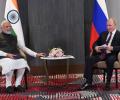
The phone conversation came days after it emerged that Modi will not be travelling to Russia for the annual India-Russia summit this year.

The Gulf countries on Monday welcomed a peace deal reached between the US and Iran to end their conflict and called for protection of maritime routes and freedom of international navigation, including the uninterrupted flow of traffic through the Strait of Hormuz.

US President Donald Trump lauded Prime Minister Narendra Modi's 'calm, cool, killer' persona at the G7 leaders' lunch in France, underscoring the deeply strategic relationship and formidable diplomatic skills of the Indian leader ahead of their crucial bilateral meeting.

Pakistan is set to host a quadrilateral summit of foreign ministers from Saudi Arabia, Egypt, and Turkiye to discuss the ongoing conflict in West Asia and explore avenues for peace negotiations.

Italian Prime Minister Giorgia Meloni's new book, 'Giorgia's Vision', reveals anecdotes from her 2023 India visit, including the widespread 'Welcome' posters and a joke about her popularity in New Delhi. She also shares insights into her diplomatic approach, emphasising personal connections over rigid formalities, and recounts interactions with various world leaders.

Foreign Ministers from Saudi Arabia, Egypt, and Turkiye convene in Pakistan for a summit aimed at de-escalating the ongoing conflict in West Asia, with Pakistan actively seeking to broker peace through dialogue and diplomacy.
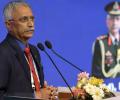
Former Army Chief General (retd) Manoj Naravane has supported RSS leader Dattatreya Hosabale's stand for fostering dialogue and people-to-people connections with neighbouring Pakistan, saying that such engagements are 'important'.

India has voiced deep concern over a drone attack targeting the Barakah nuclear facility in the United Arab Emirates (UAE), calling it a dangerous escalation in the West Asia conflict.
Pakistan is hosting a quadrilateral summit of foreign ministers from Saudi Arabia, Egypt, and Turkiye to discuss the conflict in West Asia and explore avenues for peace. The summit includes discussions on regional developments and meetings with Prime Minister Shehbaz Sharif.
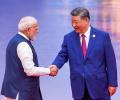
India's dual pursuit of a robust strategic partnership with Washington and a pragmatic, tension-management policy with Beijing represents the essence of modern multi-alignment. By embracing economic pragmatism, learning to compartmentalize political differences, and engaging in continuous dialogue, India can secure its borders, grow its economy, and contribute to a stable, multipolar Asian century, points out Ambassador Rajasekhar.

An India-Japan joint statement said the two leaders expressed serious concern over the conflict and the unfolding humanitarian crisis in Ukraine.

India has strongly protested to the United States after three merchant ships with Indian crew members were attacked by the American military off the coast of Oman, resulting in the deaths of three Indian nationals.

India has expressed firm opposition to attacks on merchant shipping amidst the ongoing Iran conflict, revealing that several Indian nationals have died or are missing due to these incidents. The nation also called for restraint, de-escalation, and prioritising civilian safety in the region.

US President Donald Trump has lauded India as an 'essential partner' and 'trusted ally' in addressing regional challenges, particularly its 'big role' in West Asia peace efforts, following discussions with Prime Minister Narendra Modi at the G7 Summit.

India and Australia have signed significant agreements covering civil nuclear energy, maritime security, and critical minerals, reinforcing their partnership's role in ensuring a peaceful Indo-Pacific. The pacts facilitate uranium supply from Australia to India and enhance cooperation in defence, cyber, and critical technologies.

Pakistan has intensified its efforts to bring the US and Iran back to the negotiating table to end the war in West Asia, following President Trump's extension of the ceasefire. Pakistani officials have engaged with Iranian, Turkish, and British counterparts to promote dialogue and diplomacy for a peaceful resolution.

Pakistan has strongly condemned the drone attack on the Barakah Nuclear Energy Plant in the United Arab Emirates, emphasising the grave violation of international law and the potential for catastrophic consequences.

India has welcomed the ceasefire between the US and Iran, advocating for de-escalation, dialogue, and diplomacy to secure lasting peace in West Asia.

Prime Minister Narendra Modi has strongly condemned the attacks on the United Arab Emirates' port city of Fujairah, which resulted in injuries to three Indian nationals, and reiterated India's support for peaceful resolution through dialogue.

The US and Iran have agreed on a roadmap aimed at reaching a final agreement within 60 days after hours-long talks at the Swiss resort of Burgenstock, mediators Qatar and Pakistan said on Monday, describing the progress as "encouraging."

To get its act going in Myanmar, India would need very dynamic diplomacy and not the lazy all-eggs-in-one-basket approach, points out Subir Bhaumik.

Top leaders from the US, Iran, and Pakistan, along with other nations, have gathered in Switzerland for high-level talks aimed at restoring peace in West Asia. These negotiations follow a recently signed Memorandum of Understanding between the US and Iran, initiating a 60-day window for a deal. Discussions focus on Iran's nuclear programme and the fragile interim peace deal, amidst renewed tensions and the fluctuating status of the Strait of Hormuz.

US President Donald Trump threatened to bomb Iran if a deal is not reached before the ceasefire ends, while Pakistan urged both sides to extend the truce and pursue diplomacy.

US President Donald Trump has claimed that Iran's missile capabilities have been severely degraded, saying Tehran now possesses only a fraction of the arsenal it had before recent hostilities.

India has firmly rejected Nepal's objection to the upcoming Kailash Mansarovar Yatra via the Lipulekh Pass in Uttarakhand, dismissing Kathmandu's territorial claims over the region.
